
Ever looked at a sunscreen bottle and felt like you needed a chemistry degree to understand it? You’re not alone. Most people grab whatever’s on sale, slap it on, and pray they don’t turn into a lobster by lunchtime.
But here’s the thing: choosing the right sunscreen isn’t just about avoiding a burn. It’s about protecting your skin for the long haul.
This guide will walk you through everything you need to know about sunscreen selection without the scientific jargon that makes your eyes glaze over.
From SPF numbers that actually mean something to ingredients that won’t make your face look like an oil slick, we’ve got you covered.
And that weird myth about dark skin not needing protection? Let’s just say you’ll want to stick around for that part.
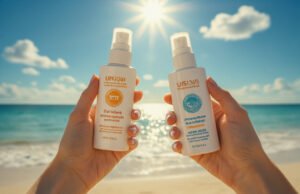
Understanding Sunscreen Basics
Why Sun Protection Matters for Your Skin
The sun’s doing more damage than you think. Every time you step outside without protection, you’re basically inviting those UV rays to age you faster. Not trying to scare you, but skin cancer rates keep climbing year after year – in fact, more than 9,500 people in the US are diagnosed with skin cancer every single day.
Here’s what happens: UV radiation penetrates your skin and damages your DNA. That leads to wrinkles, dark spots, and that leathery texture nobody wants. And that’s just the cosmetic stuff.
I remember my grandmother’s hands – beautiful but marked with age spots that she always tried to cover up. She used to tell me, “I wish I’d worn gloves and sunscreen when I was young.” It wasn’t vanity talking; it was regret about not protecting what she had.
Sunburns aren’t just painful—they’re dangerous. Just five sunburns in your lifetime doubles your risk of melanoma. That’s the deadliest form of skin cancer, by the way. Even one severe sunburn during childhood or teenage years more than doubles your chances of developing melanoma later in life.
Even on cloudy days, up to 80% of those rays still reach your skin. And sitting by windows? Yeah, UVA passes right through glass. I learned this the hard way during a long road trip – my left arm got noticeably darker than my right just from resting it near the car window.
Key Point: UV damage is cumulative. Every unprotected minute in the sun adds up over your lifetime, so starting good habits now matters regardless of your age.
Decoding SPF: What the Numbers Really Mean
SPF numbers confuse everyone. Here’s the simple version: SPF 30 blocks about 97% of UVB rays. SPF 50? About 98%. SPF 100? About 99%. Not a huge difference, right?
The number actually tells you how much longer you can stay in the sun without burning compared to unprotected skin. So if you’d normally burn in 10 minutes, SPF 30 theoretically gives you 300 minutes (5 hours) of protection.
But here’s where it gets tricky. Nobody applies enough sunscreen—most people use about 1/3 of what they should. The recommended amount is about 1 ounce (2 tablespoons) for your entire body, or roughly a shot glass full. For just your face, think about a nickel-sized dollop.
So that SPF 30 might actually be working more like SPF 10 in real life. This is why dermatologists often recommend going higher than you think you need.
And reapplication? Non-negotiable. Every two hours, or after swimming, sweating, or toweling off. I used to think once in the morning was enough – until I got burned on a skiing trip despite applying SPF 50. Turns out, wind and reflection from snow had worn it away by noon.
UVA vs. UVB Protection: The Critical Difference
Think of it this way: UVB = Burning, UVA = Aging.
UVB rays are the ones that cause sunburns and play a major role in skin cancer. They’re strongest between 10 AM and 4 PM, and during summer months. These are the rays that SPF numbers primarily measure.
UVA rays are sneakier. They penetrate deeper into your skin, cause premature aging (think wrinkles and age spots), and contribute to skin cancer too. Unlike UVB rays, UVA intensity stays fairly consistent throughout the day and year – even on cloudy days and through windows.
Most sunscreens in the US focus heavily on UVB protection. That’s why you need “broad-spectrum” on the label—it’s the only way to know you’re getting meaningful UVA protection too.
Here’s something that surprised me: UVA rays make up about 95% of the UV radiation that reaches Earth. So if you’re not getting broad-spectrum protection, you’re missing the bigger piece of the puzzle.
Physical vs. Chemical Sunscreens: Pros and Cons
This is where things get interesting. There are basically two types of sunscreen, and they work completely differently.
Physical sunscreens (also called mineral sunscreens) contain zinc oxide or titanium dioxide. They work like tiny shields, sitting on top of your skin and reflecting UV rays away. Think of them as millions of microscopic mirrors.
Physical sunscreen benefits:
- Work immediately after application (no waiting around)
- Last longer when you’re in direct sunlight
- Cause fewer allergic reactions and skin irritation
- Better for sensitive skin, including babies and kids
- Don’t break down as quickly in the sun
Physical sunscreen drawbacks:
- Often leave that telltale white cast (though newer formulas are getting better)
- Feel thicker and can be harder to rub in
- May clog pores if you’re acne-prone
- Can be more expensive
Chemical sunscreens contain ingredients like avobenzone, octinoxate, or oxybenzone. They absorb UV rays and convert them into heat, which your body then releases.
Chemical sunscreen benefits:
- Feel lighter and more like a regular moisturizer
- Blend invisibly into all skin tones
- Easier to apply evenly, especially under makeup
- Often include additional skincare ingredients
- Generally more affordable
Chemical sunscreen drawbacks:
- Take about 20 minutes to become effective (you need to apply before going outside)
- Break down faster in direct sunlight
- More likely to cause skin reactions in sensitive people
- Some ingredients may disrupt hormones (though research is still ongoing)
- Certain ingredients harm coral reefs
Your best bet? Choose based on your skin type and activities. If you have sensitive skin or rosacea, physical formulas are usually gentler. If you’re planning sweaty activities or need something under makeup, a water-resistant chemical sunscreen might work better.
I personally keep both types around – a physical one for my face daily, and a chemical sport formula for beach days and hiking. There’s no rule that says you have to pick just one and stick with it forever.
Pro Tip: If you’re trying a new sunscreen, test it on a small patch of skin first. Apply it to your inner wrist or behind your ear for a few days to make sure you don’t react before using it all over your face or body.
The bottom line? The best sunscreen is the one you’ll actually use consistently. Don’t get so caught up in finding the “perfect” formula that you end up going without protection while you’re still deciding.